Sunday, March 29, 2009

Dongdaemun & Beads

I mentioned earlier about the I'Park mall and its lack of "place." The same could be said for Dongdaemun Shopping Town, where I went yesterday to scope out Seoul's bead selection.

Again, the whole place was sorted into categories by floor, and each floor was not part of some larger, individual whole but rather a collection of market stalls, each a different vendor. They all had business cards for the taking, and I did pick up a few, but for the most part I found myself too overwhelmed to make any purchases. There wasn't really any kind of atmosphere of creativity or browsing, just "bali bali!" Quickly, quickly! This was a place to go when you knew exactly what it was that you needed. Which I did, but it quickly became apparent that what I needed was simply not to be found (Rhodonite nuggets, ~16mm or so) or probably quite readily found, if you only knew where to look—which I didn't. Add to that the fact that there's a specific lexicon to use with jewelry supplies that you probably never learn when studying English and thus asking the clerks for help is probably useless, and it all adds up to chaos. (To be fair, I didn't try to ask anyone if they had 3-strand separators—maybe they would have understood me and been able to produce some for me.)

Additionally, Koreans seem to tend towards "bling." I had noticed this before, looking at the jewelry selection in LotteMart or the Korean teachers' accessories (case in point: a tie with rhinestones in the design), but it was cranked up to 11 in Dongdaemun. Lots of sequins and rhinestones and so on, big ugly pins encrusted with Swarovski AB crystals (or, more likely, the Chinese knock-off thereof). Not really any kind of selection to be had in gemstones, in either kind or shape: just strands and strands of most-likely-Chinese stones just in generic smooth, round styles. One stall had a surprising array of shapes in hematite, but that was it.

The one surprising find was an absolute plethora of wooden beads and charms. I splurged and spent 10,000 Won on what looks to be heavily-lacquered wood with Hangul writing (which I'll have translated tomorrow). There were also a few stalls which had some interesting stuff going on in (what I assumed to be) jade, and pretty much every stall had a table or two devoted to freshwater pearls, in all shapes and colors. Charms also seemed to be pretty popular, though again a lot of them suffered from "bling" syndrome. I also found, among other things, $100 bill and Confederate Flag charms. Oh, Asia.

Every stall functioned to the same standard: clerks sat behind tables, sometimes just in rectangles, other times set up in miniature labyrinths where you could actually walk inside the "store" and poke around. The beads either hung in strands or sat individually in dishes and tins on the table. Merchants hung strands from every conceivable place: pegboard behind them, hooks attached to their tables, hooks attached to the top of their stall, etc. All of the stalls also sold jewelry, which the some of the merchants worked on while they helped you shop. It felt very sweatshop like, actually, since they seemed to work without any sense of creativity or artistic fulfillment but just to make a product as quickly as possible. Bali, bali! It actually gave me the willies.

The big difference between Dongdaemun and I'Park (aside from Dongdaemun's sole focus on crafts and handiworks) is that Dongdaemun is absolutely filthy. The floors were just bare concrete, with garbage tossed about haphazardly. This was also a contributing factor to the "I feel like I'm in a sweatshop" feeling. I'Park is equally big and busy but it's also very clean and shiny.

There is one other bead shop in Seoul, in Namdaemun shopping town. It's actually a chain stationary store, so I'm skeptical of what they have in the way of jewelry supplies, but it also sounds much less skeevy than Dongdaemun. For that reason alone I'm willing to check it out.

Friday, March 27, 2009

Cuisine

Let me introduce to you my very good friend, dolsot bibimbap. Or "돌솥 비빔밥" if you're Korean:


It's basically just rice, vegetables, sometimes meat, and an egg that fry together in a piping hot stone bowl. Oh, and with gochujang: red chili pepper paste. Sometimes they fry the egg before and put it on top.

This is my lunch every day. The aforementioned hole-in-the-wall diner does up a nice big bowl of it for 4,500 Won: $3.10 US or so. Their particular recipe is meatless, but includes: soybean sprouts, lettuce, chuinamul, and I think daikun but I'm unsure.

The best thing about this particular establishment is, once they noticed that I was leaving a gob or two of the gochujang on the side of the bowl (as well as a lot of leftover rice because it's a LOT of food!) they started making me a smaller serving with less gochujang.

You can also just have straight up bibimbap, which isn't quite as good. The vegetables and the egg are fried separately, and then they're both put on top of a cold bowl of rice.


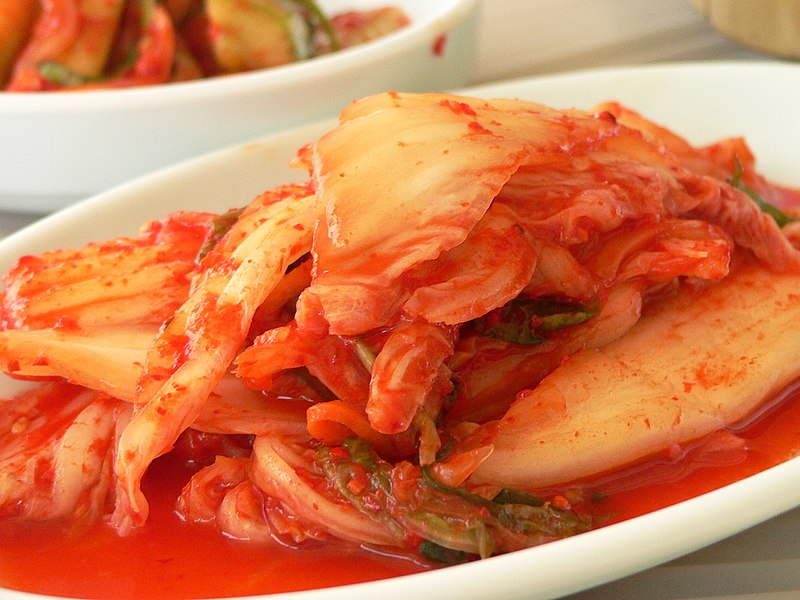
Here's another friend of mine, not a meal in and of itself but something that's served as a side. A Korean meal typically comes with bowls or trays of side dishes that you share with the other people with you. The most popular one by far is Kimchi, or 김치:


Pickled vegetables (most often cabbage) and seasonings. I had this once, by accident, at a Zen retreat I went to in December, and didn't much care for it. But now that I know what to expect when I put it in my mouth, it's pretty good.


And finally, the other teachers tipped me off early on as to the best place to get pizza in Korea. I can continue the family tradition of Friday night pizza all the way across the world by going to:


Yes, PIZZA SCHOOL. 5000 won gets me a personal pizza that's big enough to feed two, complete with stuffed crust and SURPRISE CORN. I don't understand why Koreans feel it necessary to include corn in their pizza, but there you have it.

Thursday, March 26, 2009

A Typical Day

My workday doesn't start until 1.30 PM or so. Still, I'm usually up by 9. Until I have to go, I waste time in my apartment or maybe go grocery shopping.

Once at work, I spend half an hour planning lessons, then we have off for our half-hour lunch break. A few of the other foreign teachers have a routine of going to what I guess is the Korean equivalent of a diner, and I've sort of blobbed on to it. It's a bit of a hole in the wall, with bright yellow walls and tiled floor, limited seating and a stove right in the middle of the place. You call in your order beforehand and they have it ready for you when you arrive, or soon after. It's just two women who run the place, and do all of the cooking, serving, etc. There's no cash register or check, when you're ready to leave you tell them you want to pay and then tell them what you've ordered. You pay up and all of the money lives in a little woven box on a table by the door. But the food really deserves its own post, so more on that later.

After lunch we wander back to Sherlock Academy, where we finish planning whatever lessons we have left. The first class of the day at Sherlock starts at 2.50, but only one of us (or, one foreign/Korean teacher pair) has a class then, so that's another 45 minutes to plan or just mess around. I usually read or browse the Internet if a computer is available.

Classes run on alternate schedules, so one day I'll have one set of classes and the next day I'll have my other set of classes, etc. I have four classes both day (one of which just started this week). Today, I didn't have a class until 4.30, but during the 3.40 class period I had one of my students in for extra tutoring because he doesn't understand phonics worth a damn. (His English name is "Casey"; on the last quiz he had, he put the name "Cash.") There's anywhere from three to eleven students in a class. I probably have about 65 students all told.

The last class runs from 7.10 to 7.55. After that, I stay for another half hour or so to grade tests or, like today, babysit the study hall that they have in the "Library" room. That's a rotating responsibility; I have it every other Thursday. Then I go home, have a really lazy dinner like PB&J or, if I'm feeling ambitious, pasta. After an hour or two of reading or cruising the Internet, I go to bed.

Classes, as I mentioned before, are very structured and repetitive. I always start out by calling roll, checking off homework, and handing back quizzes (they have vocabulary quizzes every other day). Then there's an obnoxious little ritual where I have them spell out the date for me. ("What day is it today?" "Today's Thursday." "How do you spell 'Thursday'?" etc), then I assign the homework for tomorrow. I go over vocabulary and, if they're young enough, their current storybook, including such riveting tales as "Good For You," "Crossing the Road," and "Richie the Greedy Mouse." Then comes the actual "lesson." Usually this means going over a page in their textbooks and then playing a game to reinforce whatever the textbook had to say.

I use the term "textbook" very very loosely. It's mostly just illustrations with speech bubbles, written and developed by this skeevy-looking fellow:


David Paul


Yeah, he looks like someone you want alone with your kids for forty-minutes at a go.

It's great for teaching younger East Asian kids the alphabet and phonics but terrible for imparting any meaningful knowledge of English and it's just stupendously dumb. Here's the cover of the highest level, to give you an idea of how insipid it is:


Now imagine being 13 years old, learning from a textbook that looked like that.

It's a series, according to the back cover, where children are not "taught" language concepts, but "find out," "discover," and "learn" them.

Vomit.

Ah, I've gotten carried away. I just really, really, really can't stand that book and I want to burn it.

But yes, then the vast majority of the lesson is spent playing some kind of content-appropriate game. Occasionally there are "Exercise and Dictation" sections to do, when you get to the end of a unit, which are just fill-in-the-blank activities and then a quick listening exercise, where I read some words or phrases and they write them down. If the students are on a team that wins the game, or get a perfect score on their test, or do the exercise and dictation perfectly, then they get stickers.

The bell rings, they pack up, and then it's five minutes until the next class. Lather, rinse, repeat.

Incident Number the First

I had my very first Incident on Tuesday, though by now it has largely panned out to be nothing.

The children here are well-behaved, by and large. Sometimes they are a bit punchy, but usually not actually disruptive. There are exceptions, of course. One of them is a kid whose English name is Alex but for in-joke reasons we all refer to him as PM.

He yells, calls out answers, crawls under things, and chatters constantly in Korean (class time with the foreign teachers is supposed to be conducted in English as much as possible). As a result, I'm constantly on his case to get him just to sit down and shut up, which seems to make him grumpy and resentful and act even worse, but my options with kids I can't actually talk to are limited. I'm sure I'll figure something out eventually, though.

A charitable reading of his behavior would be unmedicated ADHD or something, but he just seems to be a huge attention whore, because the more the kids react to him, the worse he behaves. I've considered trying to ignore him but that would be useless because the other students don't. (I do have another student who's a likely candidate for $untreated_developmental_disorder, though. He eats his snot and licks his erasers. Gross. Dumb as a post, to boot.)

Anyway, back to Tuesday. After being especially grumpy because I docked his team a point when he wouldn't stop calling out answers, he started to pack up early. Two of the students called him out on it—they're not supposed to pack up until the bell—and he responded by calling them some insult in Korean, which was apparently so awful that the students went home and said they didn't want to come to class anymore—two of the better-behaved, smarter students. And when my Korean partner teacher, Mina, called PM's house to talk to his mother about it, she wasn't there and PM picked up instead. So Mina told him about what happened and said she'd tell his mother what he said, at which point he started crying and asking her not to. Mina doesn't take shit from any of the kids and said too bad. (Too bad his mom's never actually home to pick up the phone.) Whatever he said must have been a pretty serious deal. Mina wouldn't tell me what it was in Korean or what it meant, except that it was a "bad word."

Thankfully, it all has a happy ending. Or well, at least not the worst possible ending—a happy ending would be PM getting kicked out of Sherlock academy but I realize that's highly unlikely. The two students in question returned to class on Wednesday and seem to have largely gotten over it, according to Mina, which is good because I like them. I have this class again today (Thursday) so I'll be able to see for myself how it goes down.

Monday, March 23, 2009

Itaewon


That ROKetship panel pretty much sums up anything there is to be said about Itaewon, where I went with one of the other foreign teachers on Saturday, Brendan. In stark contrast to Uijeongbu, your chances of being able to have some kind of conversation in English with a random Korean off the street are pretty good, and about a third or so of the people you see milling about are white, with a few Nigerians (or at least I'm told they're Nigerians) thrown in for good measure. Actually, on our way back, a Korean fellow on the Seoul subway actually heard us speaking English and started a friendly (though halting and rather simple) conversation with us about where we were from and what we were doing in Korea, etc.

But before we could catch the subway, we had to take a bus to the station, which took maybe twenty minutes or so. The buses in Uijeongbu (not sure if this is true all over Korea yet, but I'm sure I'll find out) are not designed for comfort or luxury but purely for maximum bodies-to-bus ratio. There's single seats along either side of the bus, with a few pairs towards the back, but most of the time you stand, and you stand in sardines-like conditions.

After the bus was the subway, which took another half an hour, maybe longer, before we were in Seoul. Rides on the Seoul transit (the buses and the subway both) are done by duration. You buy a transit card (which is proximity based so all you have to do is wave it at the bus or subway gate which is really really really cool and futuristic and neat-o) and put X amount of Won on it, and a short trip might only be 1000 Won, but a longer one might be 1500 Won.

The subway platforms also serve as valuable retail space. Vending machines sell audiobooks, and you can pick up munchies at manned snack booths. Pretty clever, really, and I'm surprised I haven't seen it anywhere else.

Our first stop was an English bookstore, with both new and used titles. The fellow accompanying me wanted to pick up a fantasy book he ordered, and I ended up walking away with a very nice, gently-used edition of The Man in the Iron Mask for $3.50, $4.00 American. Right next door was the "foreign" grocery store, where Brendan restocked on deodorant.

Two points, here. First of all, there is very little distinction in every-day Korean between ethnicities. American, French, Russian, Indian—if it's not visibly East Asian, it gets lumped into one giant amorphous blob of a category called "foreign." So you see a lot of places that advertise themselves as a "foreign" restaurant and that's it. Same for this grocery store: "foreign" meant "American junk food, Indian cooking staples, and GOYA products."

The other point is that you can't easily get deodorant here. For whatever reason, Koreans just don't sweat enough to warrant it. Deodorant was something the recruiter recommended we stock up on, as well as hard-to-find spices and probably a few other things as well. I just took deodorant to heart and skipped the rest.

There's lots of bars and restaurants with English names (none of which I can remember, of course), and also stalls selling bootleg DVDs or other items of questionable origin (Chinese knock-offs of name brand products, etc). Clothing boutiques with pieces that echo the aesthetics of places on the Jersey Shore—which is to say, absolutely trashy and poorly-made—are common, too, appearing two or three to a block.

(As for the "corn-free pizza" line, yes, for reasons unknown, pizza in Korea will typically have corn in it.)

We also stopped in Yongsan to go to the I'Park Mall, which is supposed to be the largest mall in Asia. It is pretty huge but not quite a mall in the American sense. In fall semester I attended a lecture about virtual worlds in games, and the main thrust of the talk was the difference between "location" and "place." A location, according to the lecturer, is any random place in a map, virtual or offline or whatever. But a place is a location where people stop and linger and congregate. The I'Park mall is very much a location and not so much a place. There's no place to sit or relax, it's just an eight-story collection of stalls, crowned with an "e-sports" stadium, to which we paid a quick-but-obligatory visit.

Via the Internet, I found two craft stores in Seoul that carry beads, so this weekend I will probably repeat the trip (on my own!). If you don't hear from me again, it means I got lost and slept in a gutter, with all of my money spent on soju and rice cakes.

Saturday, March 21, 2009

Lulz

I came across Babo Shirts just now and I already want to hand over my first paycheck to these guys. My favorites:


(That's a soju bottle.)


(Yes, "Rock, Paper, Scissors" is a seriously big deal here.)


(For Koreans, the difference between "F" and "P" can get pretty blurry.)


(Explanation.)

Also, if you have time to kill, check out ROKetship, a webcomic about being a foreigner in Korea. Some of the jokes are a bit "go-to," but nonetheless it's a pretty straightforward depiction of things. My favorite so far:

Friday, March 20, 2009

The National Past-time

It's the middle of the World Baseball Classic at the moment and that's all I've seen on TV for the past week, especially considering that Korea was playing against Japan in the quarterfinals. (Japan eventually schooled them, by the way, and has moved on to play Team USA in the semifinals, if you cared—but it doesn't seem like anyone in America actually knows or cares about the World Baseball Classic.) Baseball on TV everywhere you go, all hours of the day—it's like a weird little slice of home. But since Korea lost, I think that will be the end of that.

Today was my first day teaching on my own, without being observed, and a few of my classes took that as an opportunity to interrogate me (or maybe distract me from actually teaching the lesson, some of the kids can be sneaky little buggers).

"Teacher! Teacher! Where are you from?"

"Teacher! You are how old?"

"Teacher! You have boyfriend?"

etc


One class was 12 and 13 year olds, so I figured they could handle something a bit trickier. I replied, "Actually, teacher's from..." and wrote Philadelphia on the board. Surprisingly enough, they read it without any problems, and looks of recognition passed across most of their faces. At first, I thought it was just because of the cream cheese, but it seems there was more to it than that.

"Teacher! You know Park Chan-Ho?"

"Who?"

One of the boys explained by way of miming a baseball pitch. Then I remembered.

"Oh! Yes, the pitcher for the Phillies. Yes, I do." The students were immensely pleased with this. Admittedly I only know about him because Mom mentioned his signing before I left, but I have no idea what his US celebrity status is (given that he's the first ever Korean-born MLB player).

Maybe with any luck (and if Park stays on with the Phils), Phillies gear will flood the market and gain the same iconic status in South Korea that the Yankees insignia has all over the world.